
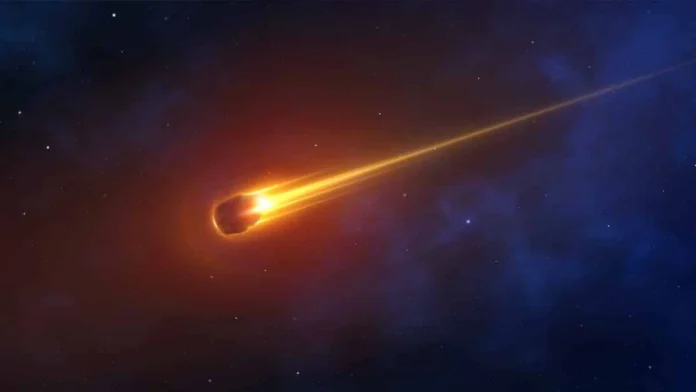
Okay, folks, buckle up, because things are about to get a little…out there. We’re not just talking about your average space rock here; we’re diving deep into the story of Interstellar Comet 3I/ATLAS, a cosmic wanderer that’s got some people whispering about alien origins. Yes, you read that right. Aliens. But before you start picturing little green men hitching a ride, let’s get the facts straight and then delve into why this comet is causing such a stir, especially among those of us who love a good conspiracy theory.
What Exactly Is 3I/ATLAS?
First off, let’s break down what makes this comet so special. Unlike the regular comets that chill out in our solar system’s backyard (the Kuiper Belt and the Oort Cloud), 3I/ATLAS is an interstellar object . That means it came from somewhere outside our solar system. Imagine it as a cosmic tourist, zipping past our sun and planets on its grand tour of the galaxy. This alone makes it scientifically fascinating, offering us a rare glimpse into what other star systems might be like. But there’s more to this story than just a cool space visitor.
The 3I/ATLAS designation is important, too. The “3I” tells us it’s only the third interstellar object ever observed (the first being ‘Oumuamua). ATLAS, on the other hand, refers to the Asteroid Terrestrial-impact Last Alert System, the telescope system that first spotted it. So, put it all together, and you’ve got a comet with a serious resume: an alien traveler spotted by a cutting-edge asteroid detection system. Let’s be honest, it’s the stuff sci-fi novels are made of.
The Alien Buzz | Where Does It Come From?
Here’s the thing: whenever something unusual like this comet pops up, the internet starts buzzing with theories. And one of the most persistent theories, fueled by the comet’s unusual composition and trajectory, is that it might not be entirely “natural.” Some suggest that it could be an alien probe, a piece of advanced technology sent out to explore the galaxy. Now, I know what you’re thinking – that sounds like something straight out of a movie. And you’re right, it does. But what fascinates me is the why behind these theories. Why do we, as humans, jump to such conclusions?
Perhaps it’s because we’re constantly searching for signs of life beyond Earth. The idea that an object from another star system could be artificial that it could represent evidence of an alien civilization is incredibly appealing. It taps into our deepest desires to not be alone in the universe. A common mistake I see people make is dismissing these theories out of hand. While it’s important to be skeptical, it’s equally important to keep an open mind. Science thrives on questioning the status quo.
Why This Matters (Even If It’s Not Aliens)
But, okay, let’s dial it back for a second. Even if 3I/ATLAS isn’t an alien spaceship (and let’s be honest, the odds are pretty slim), it’s still incredibly important. The information we can gather from studying interstellar objects like this is invaluable. They provide a unique opportunity to sample material from other star systems, giving us clues about how those systems formed and what they’re made of. It’s like getting a care package from another galaxy.
“According to NASA’s Jet Propulsion Laboratory, studying these objects can help us understand the diversity of planetary systems beyond our own.” NASA’s JPL , for instance, is deeply involved in tracking and analyzing such interstellar visitors. The analysis of the comet’s composition – the gases it releases as it approaches the sun – can reveal details about its origin and the environment it traveled through. This is a big deal for understanding the broader context of our place in the cosmos.
And there’s another angle to consider: planetary defense. Understanding the trajectories and behaviors of interstellar objects helps us prepare for potential future impacts. While 3I/ATLAS poses no threat to Earth, studying it helps us refine our models and detection systems. The one thing you absolutely must double-check regarding such celestial events is the source of your information; stick to verified scientific channels.
So, What’s Next for 3I/ATLAS?
Unfortunately, 3I/ATLAS has already made its closest approach to the sun and is now heading back out into interstellar space. But that doesn’t mean the story is over. Scientists are still poring over the data collected during its brief visit, and the lessons learned will inform future observations of interstellar objects. But, the saga continues in the analysis of all the collected data. What fascinates me is how scientists can build detailed models from so little information, it is a true feat of modern astronomy.
And who knows? Maybe one day we will find definitive proof of alien life. Until then, let’s keep exploring, keep questioning, and keep looking up at the stars with a sense of wonder. After all, the universe is full of surprises, and 3I/ATLAS is just a tiny reminder of how much we still have to learn. This is why this process is different than how we did it 20 years ago and what signals about the exam itself.
Perhaps, like Grammarly’s Evolution in the realm of language, our understanding of the cosmos will evolve in unpredictable and fascinating ways.
FAQ About Interstellar Comets
Frequently Asked Questions
What exactly is an interstellar object?
An interstellar object is any celestial body, like a comet or asteroid, that originates from outside our solar system.
How was 3I/ATLAS discovered?
It was discovered by the Asteroid Terrestrial-impact Last Alert System (ATLAS), hence the name.
Does 3I/ATLAS pose a threat to Earth?
No, 3I/ATLAS’s trajectory does not intersect with Earth’s orbit.
Can studying interstellar objects help us find aliens?
While it’s a long shot, studying these objects can provide clues about other star systems, which could indirectly inform the search for extraterrestrial life.
What is the designation ‘3I’ mean?
3I means that this is the third interstellar object ever discovered.
And remember, like understanding Daily Steps Alzheimers , knowledge about the universe requires continuous learning and exploration.


