
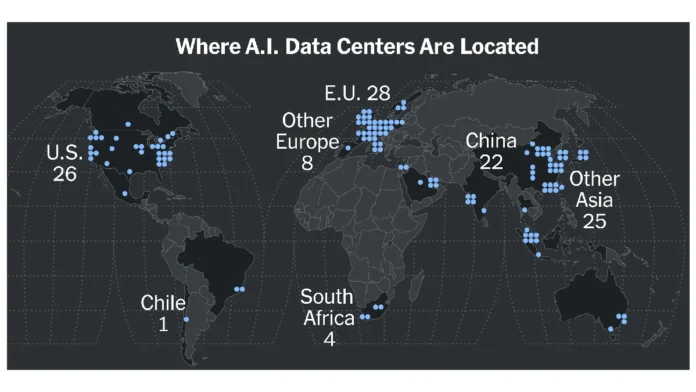
Here’s the thing: OpenAI, the folks behind ChatGPT, are making a bold move. They’re not just content with revolutionizing AI; they want Uncle Sam to help foot the bill. Specifically, they’re asking for tax credits under the CHIPS Act to be extended to AI data hubs. Now, why should you, sitting in your chai-sipping comfort in India, care about this? Let’s dive deep, shall we?
The “Why” | Decoding the Request

The CHIPS Act, officially the Creating Helpful Incentives to Produce Semiconductors Act, was designed to boost semiconductor manufacturing in the US. Makes sense, right? More chips, more tech independence. But OpenAI’s request throws a curveball. They’re arguing that AI data centers – the massive server farms that power their algorithms – are just as crucial to national competitiveness and security. What fascinates me is the hidden context here. It’s not just about saving money; it’s about securing a future where AI development isn’t throttled by infrastructure costs.
Think about it. Training these advanced AI models requires colossal amounts of computing power. We are talking about energy consumption that could power small cities! If OpenAI – or any AI innovator, for that matter – is burdened by exorbitant operational costs, innovation slows down. And in a world racing towards AI dominance, slowing down isn’t an option.
But, and this is a big but, extending the CHIPS Act to cover AI data centers opens up a can of worms. Where do you draw the line? Every tech company under the sun will be lining up for tax breaks, claiming their data centers are essential for “AI development”. The government will need incredibly stringent criteria to differentiate between legitimate claims and opportunistic grabs. This could potentially impact national security by making access to key resources more competitive.
The Indian Angle | Why This Matters to You
Okay, let’s bring this back home. India is rapidly emerging as an AI powerhouse. We have a vibrant ecosystem of startups, a massive pool of tech talent, and a government eager to embrace AI for everything from agriculture to healthcare. OpenAI’s move, and the US government’s response, sets a precedent. Here’s why it matters. It will influence how governments around the world think about supporting AI infrastructure.
If the US extends tax breaks, it could trigger a global subsidy race. India might feel compelled to offer similar incentives to keep its AI industry competitive. This could mean lower taxes for AI companies, more investment in data centers, and ultimately, faster AI development in India. A common mistake I see people make is thinking that global tech policy doesn’t affect them directly. But in an interconnected world, every major decision reverberates across borders.
Navigating the Ethical Minefield of AI Subsidies
Let’s be honest, subsidizing AI also raises ethical questions. Should taxpayers’ money be used to fuel a technology that could potentially displace jobs, exacerbate inequality, or even pose existential risks? These are tough questions with no easy answers. But they are questions that policymakers need to grapple with. I initially thought this was straightforward, but then I realized the complexities involved. The official government response has a lot riding on it.
One thing you absolutely must consider is the potential for bias in AI algorithms. If AI development is primarily driven by profit, there’s a risk that algorithms will be designed to benefit certain groups at the expense of others. Government subsidies could inadvertently reinforce these biases if they’re not carefully targeted. We need a robust framework for ethical AI development, one that prioritizes fairness, transparency, and accountability. As per the guidelines mentioned in the information bulletin, ethical concerns must be addressed. According to the latest circular on the official NTA website (csirnet.nta.ac.in), there are also safety guidelines to consider.
Furthermore, the economic impact of OpenAI’s request also should be examined. This may influence the development of future AI models.
The Future is Now | What Happens Next?
So, what’s the takeaway? OpenAI’s request is more than just a company asking for a handout. It’s a signal that AI infrastructure is becoming a critical battleground. How governments respond will shape the future of AI innovation, both in the US and around the world. Keep checking the official portal for updates. In the meantime, let’s be sure to check out the latest updates on all things trending today. This will keep you in the know.
The game has changed. The stakes are high. And the future of AI is being written as we speak. The one thing you absolutely must keep your eye on are the policy decisions and changes happening. We need to start demanding more transparency and participation in the AI conversation.
FAQ Section
Frequently Asked Questions
What exactly is the CHIPS Act?
It’s a US law designed to boost domestic semiconductor manufacturing through incentives like grants and tax credits.
Why does OpenAI want CHIPS Act funding?
They argue that AI data centers are as vital to national competitiveness as semiconductor fabs.
How could this affect India’s AI industry?
It could trigger a global subsidy race, potentially leading to more investment in Indian AI.
Are there any ethical concerns with AI subsidies?
Yes, they could exacerbate biases and inequalities if not carefully managed. Make sure that you address the ethical implications.
What if the request to subsidize the building of AI hubs is not approved?
Well, that just means that other options might come to light. There is a chance that other countries may find ways to invest in AI hubs, or perhaps the government may make changes.
Ultimately, OpenAI’s request highlights the growing importance of AI infrastructure and the need for thoughtful policies to support its development. It’s a conversation we all need to be a part of. And also, this may be good news for cloud computing.


