
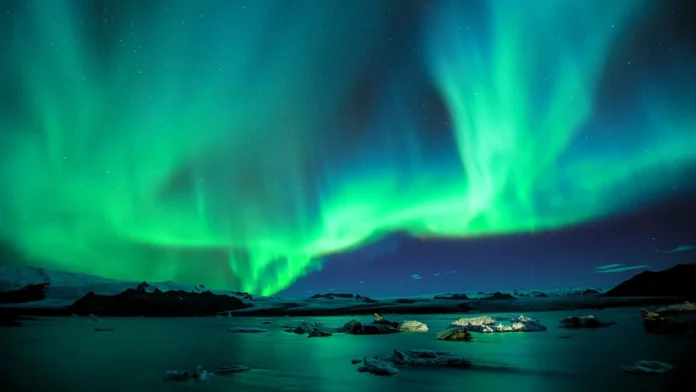
Ever looked up at the night sky and felt…something? That pull towards the cosmos, that sense of wonder? Well, imagine that feeling amplified tenfold, splashed across the heavens in vibrant hues of green, pink, and violet. That, my friend, is the Aurora Borealis , also known as the Northern Lights. But it’s not just a pretty light show; it’s a powerful reminder of the forces at play in our universe. Let’s dive deep, shall we?
Decoding the Dance | What Exactly IS the Aurora Borealis?
Okay, so we know it’s beautiful, but what is it, really? The Aurora Borealis is a natural light display in the sky, predominantly seen in high-latitude regions (around the Arctic and Antarctic). Auroras are produced when the magnetosphere is sufficiently disturbed by the solar wind that the trajectories of charged particles in both solar and magnetospheric plasma, mainly in the form of electrons and protons, precipitate them from space into the upper atmosphere (thermosphere/exosphere). That’s according toWikipediabut let’s break it down further.
Think of the sun as a giant, fiery sneeze. It’s constantly emitting particles, and sometimes, it lets out a big one – a solar flare or coronal mass ejection (CME). These particles, mostly electrons and protons, hurtle towards Earth. Luckily, our planet has a magnetic field that acts like a shield, deflecting most of these particles. But some sneak through, especially near the poles. When these charged particles collide with atoms and molecules in our atmosphere (mostly oxygen and nitrogen), they excite those atoms. And when those excited atoms return to their normal state, they release energy in the form of light – the aurora . So, in essence, the Northern Lights are a cosmic collision, a dance of particles and energy high above our heads.
The “Why” Angle | Why Does the Aurora Borealis Matter?
Okay, it’s a light show. Big deal, right? Wrong! The Aurora Borealis isn’t just a pretty picture for Instagram; it’s a window into the complex interactions between the Sun and Earth. Understanding these interactions is crucial for several reasons.
Firstly, solar activity can affect our technology. Big solar flares can disrupt satellite communications, GPS systems, and even power grids. By studying the aurora, we can learn more about solar weather and potentially predict and mitigate these disruptions. Remember that time when a solar storm knocked out power across Quebec in 1989? Yeah, that’s the kind of thing we want to avoid.
Secondly, the aurora provides clues about Earth’s magnetosphere, which protects us from harmful radiation from space. By observing how the aurora changes and moves, we can gain insights into the dynamics of the magnetosphere and how it responds to solar activity. In fact, according to the latest research from NASA, studying the auroral displays helps scientists better understand space weather events.
Thirdly, and perhaps most profoundly, the aurora connects us to the cosmos. It’s a tangible reminder that we’re not just isolated on this little planet; we’re part of a much larger system, constantly influenced by the Sun and the forces of the universe. What fascinates me is the profound impact it has had on different cultures throughout history. For some, it was a sign of impending doom; for others, it was a manifestation of spirits or gods. Either way, it filled people with awe and wonder, and that’s a feeling worth preserving. The dancing lights are not just a spectacle; they represent the interconnectedness of space and Earth.
Chasing the Lights | Tips for Witnessing the Aurora
So, you’re ready to see the sky ablaze for yourself? Awesome! Here are a few tips to increase your chances of witnessing the magic:
- Location, location, location: Head north (or south, if you’re in the Southern Hemisphere). Prime viewing locations include Alaska, Canada, Iceland, Norway, Sweden, and Finland.
- Time of year: The best time to see the aurora is during the winter months (September to April) when the nights are long and dark.
- Dark skies: Get away from city lights. Light pollution can drown out the faint glow of the aurora.
- Check the forecast: Monitor space weather forecasts. Several websites and apps can predict auroral activity based on solar activity.
- Be patient: The aurora is a fickle phenomenon. It may appear suddenly and disappear just as quickly. Be prepared to wait, and don’t give up!
One common mistake I see people make is not checking the moon phase. A full moon can significantly diminish the visibility of the aurora. The one thing you absolutely must double-check before planning your trip is the auroral forecast. These forecasts are available from various sources, including theSpace Weather Prediction Center (SWPC).
The Emotional Angle | A Personal Encounter
Let me tell you about the first time I saw the Aurora Borealis. I was in Iceland, bundled up in layers of thermal clothing, shivering in the freezing wind. I’d been waiting for hours, scanning the horizon with growing impatience. Honestly, I initially thought this was a wild goose chase, but then I realized…something in the sky. And then, suddenly, it happened.
A faint green glow appeared on the horizon, slowly spreading across the sky. It wasn’t just a static light; it was a living, breathing entity, swirling and dancing with an ethereal grace. Streaks of pink and violet emerged, adding to the spectacle. I stood there, mesmerized, tears welling up in my eyes. It was more than just a beautiful sight; it was a profound experience, a connection to something larger than myself. It’s a moment I’ll never forget. If you ever get the chance to witness the northern lights , seize it. This experience might just change your life!
Beyond the Lights | Connecting to the Cosmos
The Aurora Borealis is more than just a natural phenomenon; it’s a symbol of wonder, a reminder of the power and beauty of the universe. It connects us to the cosmos, sparking our curiosity and inspiring us to explore the unknown. So, the next time you see a picture of the Northern Lights, take a moment to appreciate the science behind it, the cultural significance it holds, and the sheer, breathtaking beauty it represents. But, let’s be honest, it’s something you should definitely experience firsthand! You can read more about the solar windshere.
FAQ About Aurora Borealis
What causes the Aurora Borealis?
The Aurora Borealis is caused by charged particles from the sun interacting with the Earth’s atmosphere.
Where is the best place to see the Aurora Borealis?
The best places to see the Aurora Borealis are in high-latitude regions like Alaska, Canada, Iceland, Norway, Sweden, and Finland.
When is the best time to see the Aurora Borealis?
The best time to see the Aurora Borealis is during the winter months (September to April) when the nights are long and dark.
Can you see the Aurora Borealis from anywhere in the world?
While the Aurora Borealis is most commonly seen in high-latitude regions, strong solar storms can sometimes make it visible in lower latitudes.
How long does the Aurora Borealis last?
The duration of an auroral display can vary, lasting from a few minutes to several hours.
What is the difference between Aurora Borealis and Aurora Australis?
The Aurora Borealis occurs in the Northern Hemisphere, while the Aurora Australis occurs in the Southern Hemisphere.


