
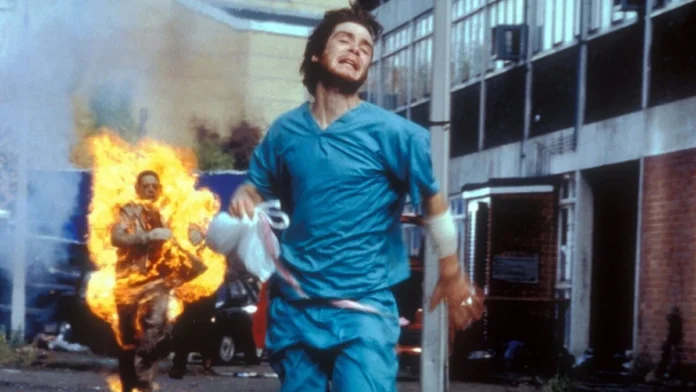
Okay, let’s be honest. When you hear ” 28 Days Later ,” your brain probably conjures images of snarling zombies and a desolate London. And rightly so – Danny Boyle’s masterpiece is a visual feast of post-apocalyptic horror. But what if I told you that beyond the scares, the film offers some seriously insightful, and frankly, terrifying, lessons about how society might actually crumble in the face of a real pandemic? Yeah, I know, a bit heavy, but stick with me.
The Speed of Societal Breakdown

What really sets ” 28 Days Later ” apart is its depiction of how ridiculously quickly things can fall apart. We’re not talking months or years; we’re talking days. The Rage virus, with its unbelievably fast incubation period, exposes just how fragile our social structures are. Think about it: within a week of the initial outbreak, London is deserted, infrastructure collapses, and basic services vanish.
But, this isn’t just movie magic . Experts in disaster preparedness have long warned about the cascading effects of a pandemic. A highly contagious and virulent disease could overwhelm healthcare systems, trigger mass panic, disrupt supply chains, and ultimately, lead to a breakdown of law and order. It is something to think about.
What fascinates me is how the film doesn’t shy away from showing the human cost of this collapse. It’s not just about fighting off zombies; it’s about the moral compromises people make when pushed to the brink. Which brings us to…
The Dark Side of Human Nature (and the Importance of Hope)
One of the most chilling aspects of ” 28 Days Later ” isn’t the infected; it’s the uninfected. Specifically, the soldiers holed up in a military base, led by the disturbingly pragmatic Major Henry West. West represents the chilling reality that in a survival situation, some individuals (and institutions) will prioritize power and control over basic human decency.
I initially thought the Major was just a one-off villain, but then I realized he embodies a darker truth: that even in the face of unimaginable horror, the potential for exploitation and abuse remains. The film doesn’t offer easy answers; it forces us to confront the unsettling possibility that the biggest threat in a pandemic might not be the virus itself, but what it reveals about our own capacity for cruelty.
But – and this is crucial – the film also offers a glimmer of hope. The protagonists, Selena, Mark, and Frank, represent the enduring power of human connection, resilience, and the unwavering belief in a better future. Their journey, fraught with peril, underscores the importance of compassion and cooperation in the face of adversity. This is the message that stays with you.
The Underrated Role of Preparedness (Beyond Toilet Paper)
Everyone remembers the toilet paper shortages of 2020, right? ” 28 Days Later ” highlights that true preparedness goes far beyond stocking up on essentials. It’s about having a plan, a network of support, and the mental fortitude to navigate unimaginable challenges.
Consider this: the film’s protagonists survive not just because they’re good at killing zombies (although that helps), but because they’re resourceful, adaptable, and willing to learn new skills. They scavenge for supplies, find shelter, and, most importantly, work together.
The film, at its core, is a stark warning of the dangers of complacency and a powerful reminder of the importance of individual and collective action in mitigating the impact of a pandemic. And this isn’t just my opinion; as seen in this study by NCBI , the lessons that movies like ” 28 Days Later ” teach us are extremely important.
So, what’s the takeaway here? Beyond the jump scares and zombie mayhem, ” 28 Days Later ” offers a surprisingly relevant commentary on societal fragility, the complexities of human nature, and the critical importance of preparedness.
We are all susceptible to things that can go bump in the night.
The Environmental Angle | Is Rage Natural?
I am beginning to wonder whether the “Rage” virus in ” 28 Days Later ” is something we should be seeing in ourselves as a species. The rapid spread of the virus and the subsequent social decay, at its core, exposes humanity’s existing vulnerabilities. So, instead of seeing the movie as a scary story, we should see it as a projection of what is within ourselves, and not necessarily what we are susceptible to in nature.
FAQ | Surviving Your Own “28 Days Later” Scenario
What’s the first thing I should do in a pandemic outbreak?
Secure clean water and a reliable food supply. Then, establish a safe and defensible shelter.
How important is having a community?
Absolutely crucial. Isolation is a death sentence. Find trusted allies and work together.
What if I forgot my bug-out bag?
Improvise! Use what you have available to create essential tools and protection. Think resourcefulness, not perfection.
Is it ethical to defend myself against other survivors?
A tough question. Morality becomes blurred in a survival situation. Focus on de-escalation and self-preservation, but be prepared to defend yourself if necessary.
Where should I look for reliable information during a crisis?
Stick to official sources, like the CDC or WHO. Avoid spreading misinformation or panic.
Ultimately, ” 28 Days Later ” isn’t just about zombies; it’s about us. It’s a mirror reflecting our strengths, our weaknesses, and our capacity for both destruction and redemption. And that, my friends, is far more terrifying than any Rage-infected creature. Let’s learn from this movie and be prepared for anything that may be coming down the pipe.


