

Have you ever looked up at the night sky and wondered what secrets it holds? What if I told you there’s a cosmic visitor, a massive interstellar comet, currently making its way through our solar system? And not just any comet, but possibly the largest and oldest one we’ve ever seen! Let’s dive into why this celestial event is capturing the attention of scientists and stargazers alike.
What’s the Big Deal About 3I/ATLAS?
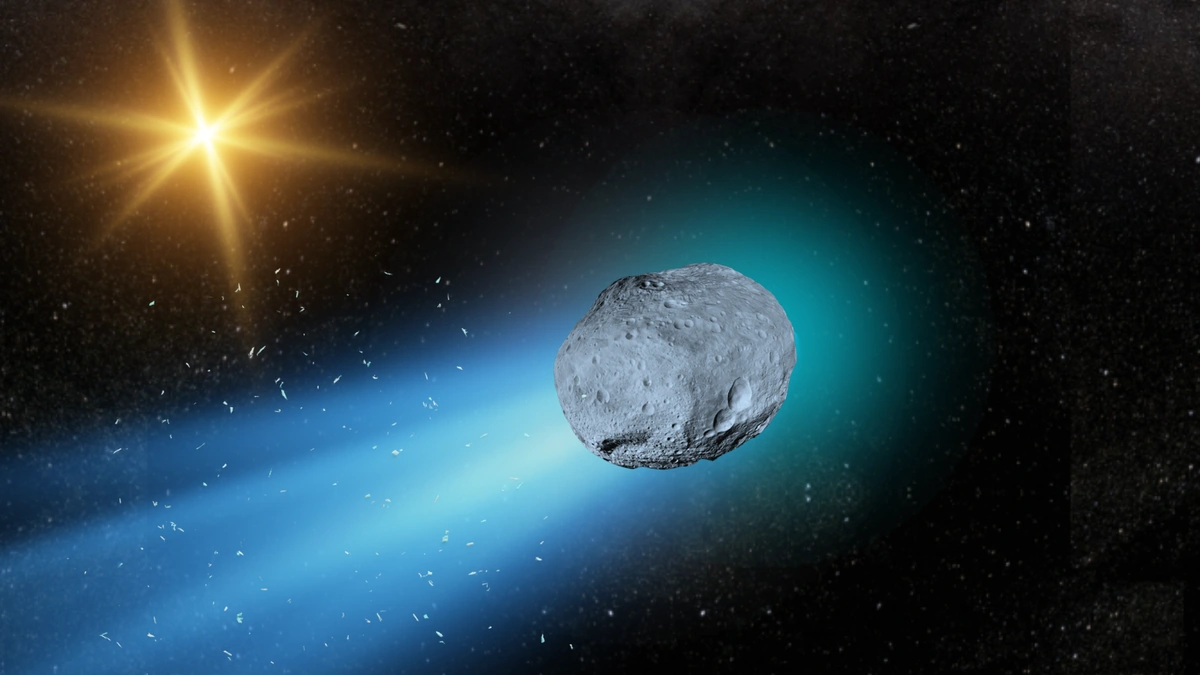
Here’s the thing: Comets aren’t exactly rare. But this one, designated 3I/ATLAS, is special. It’s not just another icy rock from our own solar neighborhood. It’s an interstellar object , meaning it originated from a star system far, far away. Imagine the journey this thing has been on! According to the latest data, this comet is not only huge but also incredibly active. As it approaches the sun, it’s releasing massive amounts of water vapor – think “fire hose,” not a leaky faucet. This intense outgassing gives us invaluable clues about its composition and origin.
Why the ‘Fire Hose’ of Water Matters
The sheer volume of water being released by 3I/ATLAS is what truly sets it apart. Comets are essentially dirty snowballs, but the specific chemical makeup of their ice can vary significantly. The fact that this comet is blasting out so much water suggests that it may have formed in a region of its original star system that was rich in water ice. What fascinates me is that by studying the isotopes in the water (different forms of hydrogen and oxygen), scientists can potentially trace the comet back to its parent star. This is like finding a cosmic fingerprint that tells us where it came from and what the conditions were like in that distant solar system.
The Journey to Our Solar System
So, how did 3I/ATLAS make its way here? Well, the universe is a chaotic place. Gravitational interactions between stars and planets can eject comets and asteroids into interstellar space. These objects then wander through the galaxy for millions, even billions, of years, until they happen to stumble upon another star system – ours, in this case. The chances of such an encounter are incredibly slim, which makes the discovery of interstellar comets like 3I/ATLAS all the more exciting. The fact that it’s passing near the Sun offers an unparalleled opportunity to study pristine material from another star system up close. The importance of the flyby of the sun grazing comet cannot be overstated as such opportunities do not come often.
Observing 3I/ATLAS | A Challenge and an Opportunity
Unfortunately, spotting 3I/ATLAS with the naked eye isn’t likely. It requires a reasonably powerful telescope and a dark sky, far away from city lights. But for amateur astronomers and professional researchers alike, this comet presents a unique opportunity. Scientists are using telescopes around the world (and in space) to monitor its activity, measure its size and shape, and analyze the composition of the gas and dust being released. These observations will not only help us understand 3I/ATLAS itself but also provide valuable insights into the formation and evolution of planetary systems in general. The study of comets has given humans a chance to explore the formation of the solar system. But analyzing interstellar comets like 3I/ATLAS can give new insights into planet formation.
And, let’s be honest, there’s something deeply thrilling about studying an object that has traveled untold distances through space and time. It’s a reminder that we are just one small part of a vast and wondrous cosmos. As per the guidelines mentioned in the information bulletin of NASA, the comet’s perihelion (closest approach to the Sun) occurred in late May 2024, but scientists continue to monitor its behavior as it moves away from the Sun.
What Does the Future Hold for 3I/ATLAS?
After its close encounter with the sun, 3I/ATLAS will continue on its journey, eventually leaving our solar system and heading back into interstellar space. We may never see it again. But the data we collect during its brief visit will continue to be analyzed for years to come, providing new clues about the origins of comets, the formation of planetary systems, and the very nature of the universe. The orbit trajectory is being carefully studied by astronomers using sophisticated equipment. According to a report on Wikipedia Wikipedia , understanding such orbits help determine the parent star of the comet. Also, keep checking the official portal of NASA, because while sources suggest a specific trajectory, the official confirmation is still pending.
So, the next time you look up at the night sky, remember 3I/ATLAS, the massive interstellar comet that once graced our solar system with its presence. It’s a reminder that the universe is full of surprises, and that there’s always something new to discover, if we just take the time to look.
FAQ
What exactly is an interstellar comet?
An interstellar comet is a comet that originated from outside our solar system. It has traveled from another star system to ours.
How big is 3I/ATLAS?
Estimating the exact size of a comet is difficult, but 3I/ATLAS is believed to be one of the largest interstellar comets ever observed.
Can I see 3I/ATLAS with my naked eye?
Unfortunately, 3I/ATLAS is too faint to be seen without a telescope.
Why is the water release so significant?
The large amount of water vapor being released provides clues about the comet’s composition and origin, potentially linking it to its parent star system.
Where can I find more information about 3I/ATLAS?
You can find updates and information on NASA’s website and other astronomy news sites.
Here’s why this comet’s composition is an invaluable piece of information. It gives us a peek into other planetary systems.


